










Water is one of the most important resources in agriculture, and using it efficiently has become increasingly important for modern farming. Traditional irrigation methods can provide adequate water to crops, but they may also result in water loss through evaporation, runoff, and uneven distribution.
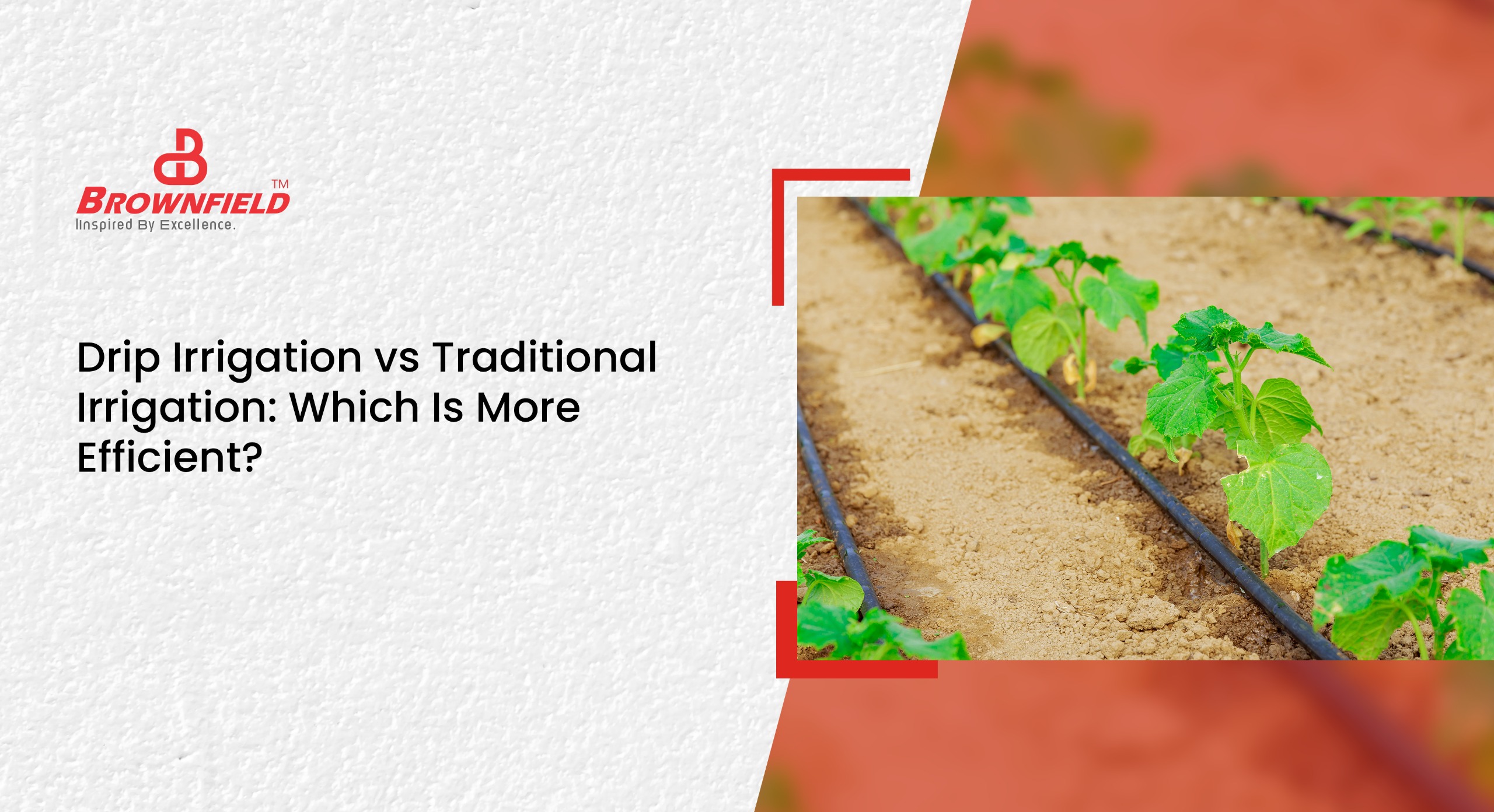
Drip irrigation offers a more targeted approach by delivering water directly to the root zone of plants. This helps farmers manage water more efficiently while maintaining suitable soil moisture for crop growth.
But how does drip irrigation actually compare with traditional irrigation? Let’s understand the key differences.
What Is Drip Irrigation?
Drip irrigation is a precision watering system that delivers controlled amounts of water directly to the root zone of individual plants. The system uses a network of pipes, tubing, valves, and emitters to distribute water at a slow and consistent rate.
By applying water close to the roots, drip irrigation reduces unnecessary water loss and helps maintain more consistent soil moisture. It is particularly useful for vegetables, fruits, orchards, nurseries, and other crops that benefit from controlled irrigation.
What Is Traditional Irrigation?
Traditional irrigation generally involves distributing water over a larger area through methods such as flood irrigation, furrow irrigation, or conventional sprinkler systems. These methods have been widely used because they are relatively simple and can cover large farming areas.
However, depending on the method and field conditions, a significant amount of water may be lost through evaporation, runoff, and deep percolation. Water distribution may also be less uniform, particularly across uneven fields.
Drip Irrigation vs Traditional Irrigation: Key Differences
| Factor | Drip Irrigation | Traditional Irrigation |
| Water Distribution | Directly delivers water to the root zone | Distributes water across a wider area |
| Water Efficiency | High, with minimal evaporation and runoff | Generally lower due to water loss |
| Crop Watering | Controlled and precise | Less precise |
| Soil Moisture | Maintains more consistent moisture near roots | Can result in uneven moisture |
| Weed Growth | Reduced as water is concentrated around plants | May encourage weeds across wet areas |
| Labour | Requires less manual watering once installed | May require more supervision and labour |
| Fertiliser Application | Can support fertigation | Usually requires separate application |
| Initial Investment | Higher installation cost | Often lower initial cost |
| Long-Term Efficiency | Can offer better resource efficiency | Depends heavily on the irrigation method |
| Suitable Applications | Vegetables, orchards, vineyards, nurseries & protected cultivation | Large fields and crops suited to flood, furrow or sprinkler irrigation |
Benefits of Drip Irrigation
Better Water Management
Drip irrigation delivers controlled amounts of water directly to the root zone, ensuring plants receive the moisture they need without unnecessarily watering the surrounding soil. This makes water usage more precise and efficient.
Improved Crop Growth
Maintaining consistent moisture around the root zone creates favourable growing conditions for plants. It helps avoid excessive watering and moisture stress, supporting healthier and more uniform crop development.
Reduced Weed Growth
Unlike irrigation methods that wet large areas of the field, drip systems concentrate water around the crop roots. Keeping the spaces between plants relatively dry can help limit unwanted weed growth and reduce competition for nutrients.
Lower Water Loss
Water delivered close to the roots is less exposed to surface runoff and evaporation compared with some conventional irrigation methods. This helps farmers make better use of available water, particularly in areas where water resources are limited.
Fertigation Capability
Drip irrigation can be combined with fertigation, allowing suitable water-soluble fertilisers to be delivered through the irrigation network. This provides more controlled nutrient application and helps distribute nutrients closer to the plant root zone.
Suitable for Different Crops
Drip irrigation can be adapted to a wide range of agricultural applications, including vegetables, fruits, orchards, vineyards, nurseries, and protected cultivation. The system can also be configured according to crop spacing, soil conditions, and water requirements.
When Should You Choose Drip Irrigation?
Drip irrigation is a suitable choice when water conservation, precise irrigation, and efficient crop management are important priorities. It is particularly useful for crops that require regular and controlled watering, such as vegetables, fruits, orchards, vineyards, nurseries, and greenhouse crops.
It can also be beneficial in areas where water availability is limited or where reducing irrigation losses is a key concern. By delivering water directly to the root zone, the system allows farmers to manage irrigation according to the specific requirements of their crops.
Drip irrigation is especially worth considering when you want to:
- Improve water-use efficiency and reduce unnecessary wastage.
- Maintain consistent soil moisture around the plant root zone.
- Reduce weed growth by limiting water distribution between crop rows.
- Improve nutrient management through fertigation.
- Reduce manual irrigation effort with a controlled watering system.
- Support high-value and closely spaced crops requiring precise irrigation.
Final Thoughts
Drip irrigation is a smart step towards more efficient and productive farming. By delivering water directly to the root zone, it helps farmers manage water more precisely, reduce unnecessary losses, and maintain better growing conditions for crops. As agriculture continues to face increasing pressure on water resources, adopting efficient irrigation practices can play an important role in improving long-term farm productivity.
Brownfield India offers reliable drip irrigation solutions designed to support the changing needs of modern agriculture. Our systems combine efficient water delivery with dependable components to help farmers achieve better irrigation control and resource utilisation. From crop fields and orchards to nurseries and protected cultivation, Brownfield India’s solutions are designed to support efficient and practical water management for diverse agricultural applications.